Start with a supported, engine-off fitting arranged by the dealer. Bring the footwear you intend to ride in and explain that you are new. Ask a qualified instructor for help if you cannot judge whether a position is workable.
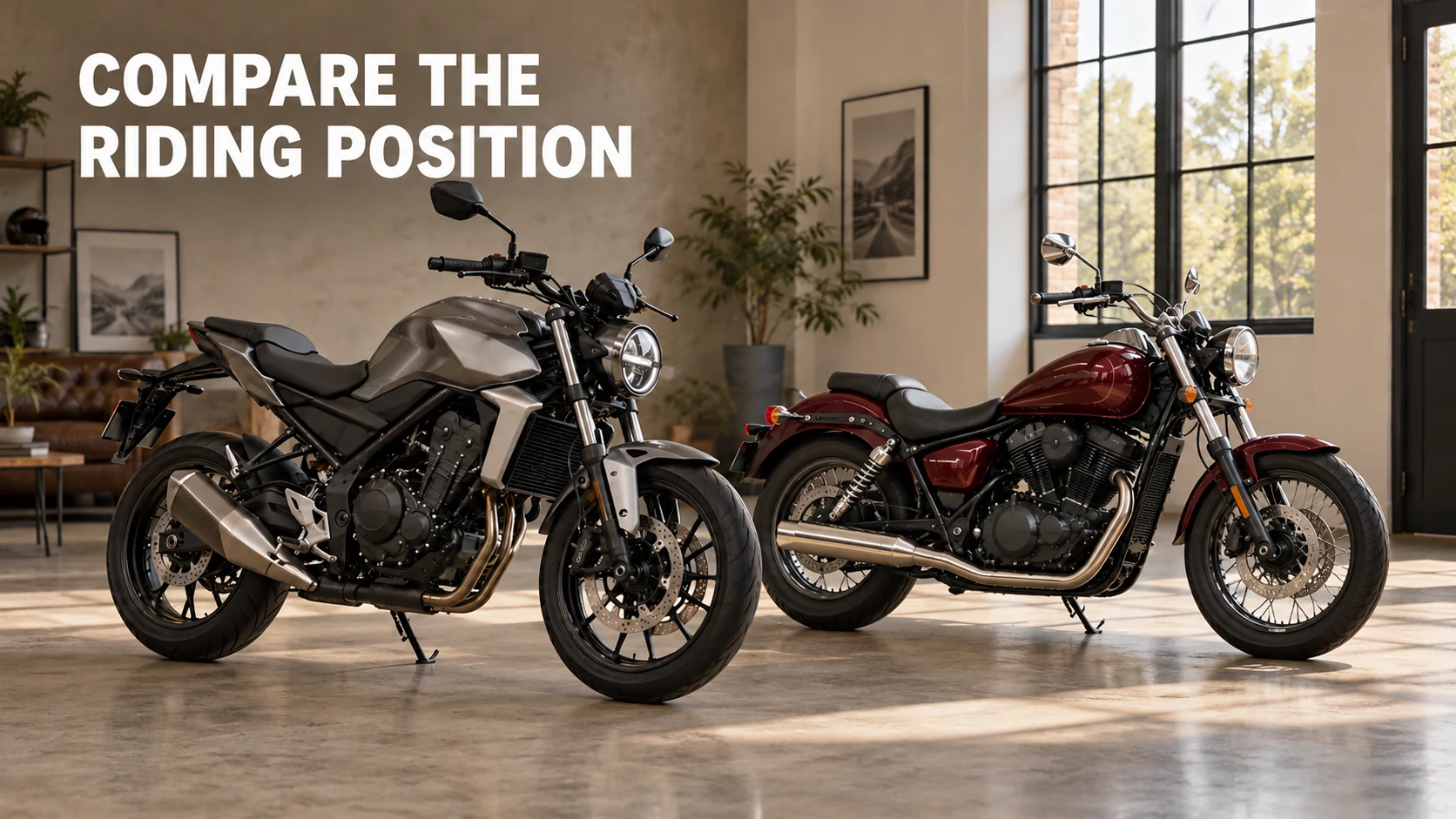
Compare the riding position, not the label
Look at the triangle formed by seat, handlebar, and foot controls on each candidate. Check whether your arms remain relaxed and whether you can reach the controls without shifting into an awkward position. Ask staff about manufacturer-supported adjustment rather than assuming an aftermarket change will solve the problem.
| Check | Ask on either style |
|---|---|
| Seat and ground reach | Does the supported fitting work with your riding footwear? |
| Hand controls | Can you reach them comfortably without stretching? |
| Foot controls | Are they comfortably accessible from the normal seat position? |
| Weight | Does the specification describe comparable ready-to-ride conditions? |
Check the exact model and year
Use manufacturer documentation, not a category-wide assumption. Honda's current Rebel 300 page describes an E-Clutch configuration; Yamaha's MT-03 page provides its own model details. These examples show where to check equipment, not which motorcycle wins. Older used versions may differ.
A low seat alone does not establish easy low-speed handling. Consider the whole fit, controls, and actual machine, with an instructor's guidance. Do not choose from displacement alone or test your ability by trying to catch a leaning bike.
For example, the cruiser you like may make ground reach comfortable while its handlebar leaves you stretching. A different candidate might solve the arm position but raise another concern. Write down both observations instead of declaring either category suitable for every beginner.
Keep a separate note for each candidate, including its exact year and version. This prevents details from one showroom visit being assigned to another motorcycle.
Make the next step a supported comparison
Describe your parking space, routes, and experience to the dealer and instructor. Ask how to evaluate suitability safely before buying. A showroom fitting cannot establish how a motorcycle will feel in traffic, and an unfamiliar road test is not a substitute for instruction.
The MSF beginner-course options offer a structured starting point. Confirm local prerequisites and equipment arrangements with the provider.
Keep it on the shortlist
The supported position works and the equipment, condition, and ownership costs are understood.
Keep looking
It requires unexplained modifications or leaves a meaningful reach, weight, or control concern unresolved.
Return to the first-motorcycle buying guide to compare training, condition, and budget before paying a deposit.