

A service menu can turn a simple appointment into a difficult purchase. One shop offers an oil change; another recommends a mileage package, a fluid treatment, and several inspections. To choose car maintenance services, start with what your vehicle needs, then compare the work each shop will actually perform. A package name is not a maintenance schedule.
The short answer
Build a list from your vehicle's maintenance instructions and service history. Ask the shop to separate scheduled work, repairs supported by an inspection, and optional extras. Compare itemized quotes for the same tasks before authorizing them. This method helps you make an informed choice; it cannot establish that a vehicle is mechanically safe without an inspection.
This guide covers buying routine maintenance for passenger cars in the United States. It does not prescribe service intervals for every engine or replace a diagnosis. Omar Haddad is a fictional editorial persona; this article is based on documentary research, not claimed workshop experience.
Start with your vehicle, not the shop's package
Before booking, collect the model year, engine, current mileage, and dates of previous work. Locate the manufacturer's maintenance information for that exact vehicle. A schedule for a similar model with another engine can create a misleading shopping list. If the booklet is missing, use the manufacturer's owner portal or request the relevant schedule from its service department.
The FTC's repair guidance recommends comparing a shop's proposed maintenance with the manufacturer's schedule for your driving conditions. A recommendation outside that schedule deserves an explanation. It is not automatically unnecessary: a documented defect may need attention before a scheduled interval.
Create three columns in a note on your phone: due now, already completed, and needs clarification. Put the evidence beside each entry. For example, an invoice confirming a recent filter replacement is more useful than remembering that the car had a “major service.” When history is incomplete, tell the shop which work is unknown instead of treating unknown as either definitely overdue or definitely completed.
Driving conditions also matter. Ford publishes special operating-condition guidance that distinguishes uses such as towing and dusty roads. This illustrates why a generic mileage package is insufficient; it is not a universal Ford interval or a schedule for other makes. Ask which condition in your own manual changes the service being recommended.
Choose a shop for the work you need
A dealership and an independent shop can both be options for routine maintenance. Compare their ability to document the correct parts, fluids, procedures, and completed work. Describe the actual job when asking for a quote. “Maintenance on my car” is too broad; “the services due under this schedule, excluding work already documented here” gives both businesses a comparable starting point.
Ask who will handle additional findings and how approval works if the shop discovers a problem. Also ask whether the quoted visit includes diagnosis of your reported symptom. An inspection, a diagnostic investigation, and a repair are different deliverables. A package that lists an inspection should not be assumed to include the labor needed to identify every fault.
For U.S. warranty concerns, the FTC explains that routine maintenance performed elsewhere does not by itself cancel warranty coverage. Damage caused by an unsuitable part or incorrect installation is a different issue. Free warranty work and separately purchased contracts can also have facility requirements. Read your own terms before choosing where covered work will happen.
Practical tip: Send the same short request to both shops, including the vehicle details, due-service list, and any symptoms. Request separate answers for scheduled maintenance and diagnosis. This makes a difference in scope visible before a difference in price dominates your decision.
Compare oil-change packages on specifications and inclusions
For an oil-change visit, begin with the oil requirements in your vehicle's manual. Terms such as “premium” or “high mileage” do not tell you everything needed to establish compatibility. Ask the shop to identify the proposed oil, relevant specification, included quantity, and filter. The American Petroleum Institute directs owners to their manuals when choosing oil performance categories.
Next, separate the core job from additional work. Does a package include a tire rotation, simply a tire check, or neither? Is an inspection accompanied by a written report? Does the total include any extra oil required and disposal fees? These questions establish what is being sold without assuming that every business defines a package the same way.
A bundle can be useful when its extra work is independently due and its total is clear. When the extras do not address your current needs, request a quote for the core service alone. Do not choose an incompatible oil merely to qualify for an advertised price.
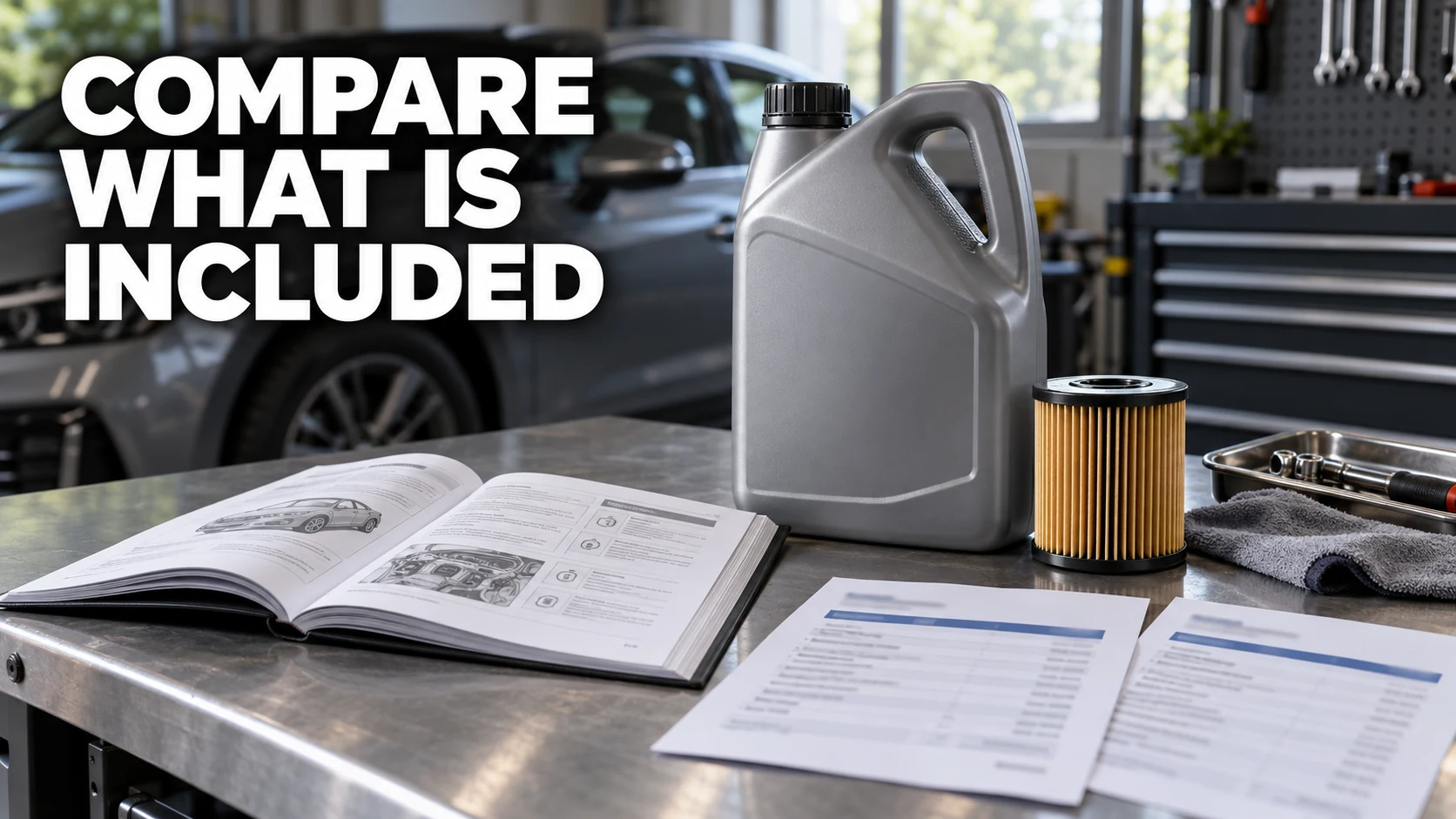
For any oil-change offer, compare the required oil specification, quantity, filter service, and written total. A package name alone does not establish compatibility. Ask for the reason behind any additional work and whether it is due or supported by a documented finding.
Decide whether a maintenance plan fits your ownership
A prepaid maintenance plan should be evaluated against services you expect to use during the period you expect to keep the car. Start with the contract's list of covered tasks and exclusions. A plan that makes booking convenient may still be poor value for a driver who cannot use its participating locations or will sell the car before using the visits.
Build a simple worksheet: covered service, expected due date, whether already included elsewhere, and current written pay-as-you-go quote. Add only services that match your vehicle and likely ownership period. Compare their total with the plan's full cost, including any stated fees. Leave an unknown price blank and obtain a quote; do not substitute an optimistic saving.
Then test the awkward cases. What happens after a move? Can unused coverage be canceled or transferred, and on what terms? Do unused service visits expire? A prepaid scheduled-maintenance product and a contract covering certain breakdowns should not be treated as interchangeable. The coverage document, rather than the product's reassuring name, determines what you are buying.
Separate scheduled work, diagnosed repairs, and optional extras
Ask the adviser to label each recommendation with its reason. Scheduled work should point to the applicable maintenance requirement. A repair recommendation should explain the finding and proposed remedy. An optional treatment should be identified as optional, with its purpose and vehicle suitability explained. This classification is a decision aid, not a remote diagnosis.
For example, if a shop recommends replacement after an inspection, ask for the recorded measurement or observation and the applicable limit or condition that justifies it. A photograph may help explain a visible issue, but it does not replace the relevant measurement or diagnostic work. Avoid turning this conversation into a blanket refusal of anything outside a mileage schedule.
Request a written estimate and an agreed approval process before work starts. California's Bureau of Automotive Repair explains its state's estimate and additional-authorization requirements. Other states have their own rules; the practical step everywhere is to ask exactly what you are authorizing, what it will cost, and when the shop must contact you again.
Do not use comparison shopping to postpone an urgent safety concern. Tell the shop about warnings or changes in vehicle behavior, follow the owner's manual's instructions, and obtain professional guidance about whether the car can be driven. This article cannot determine urgency from a package description.
Keep records that make the next decision easier
Save the estimate, your approvals, the final invoice, and any inspection report together. Check that the invoice identifies the actual services, vehicle mileage, and date. For fluids and replacement parts, ask for enough identification to establish what was installed. A vague description such as “service completed” makes later comparisons harder.
At pickup, compare the final work with your approved list. Ask the adviser to explain discrepancies before you leave. Keep recommended-but-declined work separately from completed work, together with the reason and any agreed follow-up. Declining a proposal does not establish that the underlying condition has disappeared.
Use a folder named for the vehicle and save files with the date and mileage. This is an organizational suggestion, not a required legal format. It lets you answer a future recommendation with a record rather than a guess. If a maintenance reminder was reset, confirm which service was performed; a display reading alone is not your invoice.
Your next appointment: a five-minute preparation
Prepare one message before contacting the shop: “Here are my vehicle details, mileage, service history, and the items I believe are due. Please quote those separately from additional recommendations, identify the fluids and parts, and explain the authorization process.” Add any symptoms clearly rather than hiding them inside a routine-service request.
Keep recalls separate from ordinary paid maintenance. Use the NHTSA VIN lookup and follow the manufacturer's instructions for any relevant campaign. The lookup has limitations, including some newly announced recalls and older campaigns; a clear result is not a complete mechanical inspection.
Choose the offer you can explain in plain language: the right work for your vehicle, a reason for each task, a clear total, and a record afterward. That is a more useful purchasing standard than the longest checklist or the lowest headline price.